Closing the Trust Gap in Web3 Settlement
How Syklo's autonomous escrow and Yanez's Proof of Humanhood and Proof of Uniqueness close the human-trust gap that legacy OTC settlement leaves open

What You'll Learn OTC and escrow settlement remains one of the weakest links in Web3 — not because of broken cryptography, but because it still asks a human to trust a piece of communication. This article walks through: • A real Bittensor subnet OTC exploit, examined precisely — including the open question of whether the escrow agent was deceived or complicit, and why the structural lesson holds either way. • Why the same failure mode recurs in P2P triangle scams, large-scale escrow fraud, and AI deepfake-enabled wire transfers — with documented losses now in the billions annually. • How Syklo's code-constrained escrow removes unilateral release authority from the normal settlement path — and how dispute adjudication remains bounded and non-custodial rather than disappearing entirely. • How Yanez's Proof of Humanhood and Proof of Uniqueness close the remaining gap — verifying that the party authorizing a transaction is a real, unique human, without exposing any personal data. • A combined Syklo + Yanez settlement model that maps directly against each fraud pattern covered. |
The Settlement Layer Is Where Web3 Still Trusts Humans
Decentralized infrastructure has made remarkable progress at removing trust from custody, computation, and consensus. Smart contracts execute exactly as written; validators reach agreement without a central referee; cryptographic proofs replace institutional vouching. Yet one stage of the value chain has stubbornly resisted this shift: settlement. The moment a digital asset needs to convert into fiat currency, or a large block of tokens needs to change hands off the public order book, most participants still rely on something a 2010s bank transfer relied on — a human being, somewhere in the loop, believing a piece of communication.
Over-the-counter (OTC) trading exists because public liquidity is often too shallow to absorb large trades without significant slippage. For emerging projects, specialized tokens, and protocol treasuries, OTC is frequently the only practical way to convert accumulated digital assets into the operating capital needed for infrastructure, payroll, and runway. That necessity creates a predictable vulnerability: the larger and more urgent the trade, the more attractive a target it becomes, and the more legacy escrow's reliance on human judgment becomes a liability rather than a safeguard.
Case Study: A Bittensor Subnet OTC Settlement Exploit
A representative example of this exposure played out with a Bittensor subnet owner attempting to convert a large block of native alpha tokens into fiat to fund infrastructure and payroll. Because secondary liquidity for the subnet's token was shallow, the owner turned to a third-party legacy escrow arrangement to facilitate a trade with a counterparty presenting as an institutional buyer.
Based on the subnet owner's own account, the sequence of events was narrower than a typical fabricated-document scam, and worth stating precisely because the precision matters for what follows:
• Initiation — the buyer agreed to terms and a standard escrow setup was put in place.
• Impersonation — once tokens were deposited into escrow, the fraudster contacted the escrow agent by text message, posing as the seller (the subnet owner), and asserted that the offsetting fiat funds had already been received.
• Release — relying on that message, the escrow agent released the tokens to the buyer before any fiat had actually arrived at the subnet owner's account.
Two things are worth being clear about. First, the publicly available account does not describe fabricated bank statements, forged receipts, or spoofed banking platforms — what is documented is a text-based impersonation of the seller, paired with an unverified claim that funds had cleared. Second, there are two distinct explanations for why the escrow agent acted on that claim, and the public record does not establish which one applies: either the agent was deceived by a plausible-looking impersonation and acted in good faith, or the agent was complicit in the scheme. The subnet owner has stated a belief that the escrow agent was reliable and not a knowing participant, but no public evidence currently confirms the agent's good faith. This is a real factual gap, and the article does not resolve it.

The Bittensor OTC exploit: a single human escrow agent with unilateral release authority acts on an unverified message, whether because that agent was deceived or because that agent was compromised.
What does not depend on resolving that gap is the structural diagnosis. In either explanation, the single point of failure is the same: one human held unilateral authority to release the tokens, and that authority could be activated by a message rather than by independent verification of the underlying fiat transfer. If the agent was fooled, the failure mode is that a human-in-the-loop release process can be deceived by a sufficiently confident impersonation. If the agent was complicit, the failure mode is that a human-in-the-loop release process can be corrupted by the very party meant to safeguard it. A settlement design that removes unilateral human release authority closes both paths at once, which is why the distinction does not need to be settled before drawing a lesson from the incident.
The vulnerability did not sit in smart contract logic. It sat in the fact that a single human held the authority to release funds based on an unverified claim — whether that human was deceived or compromised changes who is at fault, not what should be fixed.
A Broader Pattern: This Is Not an Isolated Incident
The Bittensor case is illustrative precisely because it is not unusual. The same structural weakness — a settlement process that gives one human unilateral release authority, activated by a message rather than independent verification — recurs across OTC desks, peer-to-peer marketplaces, and corporate treasury operations throughout Web3 and traditional finance alike. The specific techniques vary; the structural flaw does not. Three patterns are worth examining in detail.
3.1 The Triangle Scam
Peer-to-peer trading platforms have become a frequent target for what is often called triangle fraud, a scheme that exploits the mutual trust and decentralization that make P2P markets attractive in the first place. A fraudster posts an enticing offer, draws in a buyer, and separately initiates a trade with a legitimate P2P seller of cryptocurrency. Rather than paying the seller directly, the fraudster connects the buyer to the seller's payment details.

A triangle scam: the fraudster never touches the funds or the crypto directly, routing both through two unrelated, legitimate parties.
The buyer transfers funds believing they are paying for the original offer; the seller receives those funds and, believing it is payment for the crypto trade, releases the asset to the fraudster. Both legitimate parties walk away having done nothing wrong on the surface, yet one has lost goods or crypto and both may find themselves entangled in a fraud investigation neither initiated. Industry surveys have found that a meaningful share of P2P banking customers report having been victimized by exactly this kind of scam within a single year.
3.2 Fabricated Banking Confirmations at Scale
The Bittensor case shows the lightest-weight version of this technique — a single impersonating message, with no document at all. Elsewhere, the same underlying gap is exploited with more elaborate props. Industry trackers covering crypto-native escrow abuse have documented escrow-based settlement services being used at significant scale to move illicit funds between crypto and the traditional financial system, often relying on fabricated payment confirmations and trust-based handoffs that human escrow agents are poorly equipped to verify in real time.

The generic pattern behind fabricated-confirmation fraud: a forged document passes review because no real-time banking check exists to contradict it.
Separately, dedicated analyses of OTC-specific fraud have estimated tens of millions of dollars lost to schemes in which fraudulent actors posed as legitimate escrow facilitators, underscoring that the failure mode is structural rather than anecdotal: wherever a settlement process inserts a human judgment call between asset release and funds verification, that judgment call becomes the attack surface.
3.3 Deepfake-Enabled Executive Impersonation
If fabricated documents and spoofed messages represent one generation of social engineering, AI-generated audio and video represent the next, and the financial impact has scaled accordingly. Multiple documented incidents now describe finance staff authorizing large transfers after live video calls in which every other participant — including a purported CFO — was an AI-generated likeness with synchronized facial movement and a cloned voice matched to the real executive's speech patterns.

Deepfake-enabled executive impersonation: a familiar face and voice are treated as sufficient proof of identity, with no independent verification step in the loop.
One widely reported case involved a finance employee completing fifteen separate transfers totaling tens of millions of dollars after what appeared to be a routine internal video conference with senior leadership; the fraud was only uncovered later through manual verification with corporate headquarters. A separate case in Switzerland saw an entrepreneur transfer several million Swiss francs over a two-week sequence of calls after fraudsters used cloned audio to impersonate a trusted business partner. Industry trackers attribute roughly a billion dollars in deepfake-enabled fraud losses in the United States in 2025 alone, nearly triple the prior year's figure, with individual enterprise incidents now reaching the tens of millions of dollars each.
Figures and incidents in this section are drawn from public reporting by TRM Labs, Biometric Update, CyberAngel, and industry deepfake-fraud trackers; see sources cited at the end of this article.
What unites the Bittensor case, the triangle scam, and deepfake-enabled wire fraud is not the sophistication of the attacker's tooling — in the Bittensor case there was essentially none. It is the same underlying design flaw: a settlement process that lets a single human treat a communication — even an unverified text message claiming a fact, let alone a fabricated document, face, or voice — as sufficient grounds to release funds or assets. The amount of effort an attacker has to spend varies enormously; the structural opening they are walking through does not.
Removing the Human Trust Layer: How Syklo Works
Syklo (syklo.io) addresses this failure mode by removing discretionary human release authority from the normal settlement path. Rather than a person reviewing a wire confirmation and deciding whether to release an asset, Syklo's counterparty trading mechanism operates as a code-enforced escrow: no asset or corresponding value moves until every predefined condition of a dual-sided trade is independently verified and satisfied by the protocol itself.
This distinction matters because it changes what an attacker has to defeat. Against a legacy escrow desk, an attacker needs to produce a convincing fake — a forged bank receipt, a spoofed email, a cloned voice on a phone call. Against a code-constrained settlement layer, there is no unilateral escrow agent in the happy path for an attacker to persuade. A forged document or a synthetic voice has nothing to act on, because the release condition is checked against verifiable on-chain or cryptographically attested state rather than a narrative someone is asking a person to believe.
Settlement Flow: Legacy Escrow vs. Code-Enforced Escrow
Legacy Escrow (Vulnerable) | Syklo Code-Enforced Escrow (Resilient) |
1. Owner locks tokens with a third-party escrow desk. | 1. Owner locks assets in a code-enforced smart contract. |
2. Fraudster submits a fabricated bank receipt or spoofed message. | 2. Fraudster attempts to inject a fake confirmation or communication. |
3. A human agent reviews the communication and is deceived. | 3. The protocol checks verified settlement conditions directly; the fabricated input has no point of entry. |
4. Assets are released to the fraudster before real funds arrive. | 4. Assets remain locked; the attack fails by design. |
Removing unilateral release authority from the happy path closes the attack surface that fabricated documents and spoofed communications are built to exploit.
Happy-Path Automation vs. Dispute-Path Adjudication
It is worth distinguishing between two different moments in an escrow flow: the ordinary happy path, in which a trade settles as intended, and the exceptional disputed path, in which something has gone wrong off-chain.

Syklo's settlement flow: fabricated confirmations have no release step to act on in the happy path; genuine disputes route to a separate, bounded adjudication step.
In the happy path, Syklo does not give an escrow agent discretionary authority to release assets on the basis of a message, receipt, email, phone call, or banking screenshot. Release is governed by the counterparties and by the trade's predefined settlement conditions. This is precisely why the Bittensor-style failure described in Section 2 does not map cleanly onto Syklo's normal flow: the critical failure in that incident was that a human escrow agent held unilateral release authority that could be activated by an unverified message, whether because the agent was deceived by the impersonation or because the agent was compromised. Syklo's design is agnostic to which explanation is correct, because it removes the unilateral action itself: that single point of authority does not exist as an available step on the happy path.
This does not mean human involvement disappears from every possible scenario. Real-world settlement can still produce disputes — a party may claim non-payment, partial payment, incorrect payment details, fraud, or coercion. In those cases, adjudication may still require human review. The distinction is that the reviewer is not a traditional escrow agent holding full custody and unilateral release power. A dispute-path adjudicator participates only after a dispute has been raised, and typically holds limited authority — such as a single key within a broader multisignature or escrow structure — rather than full control over the locked assets.
This changes the underlying trust model rather than eliminating trust altogether. Legacy escrow asks participants to trust that a human agent will neither be deceived nor be corrupted, and will not release funds prematurely under either condition. Syklo instead constrains what any human reviewer is structurally able to do. A disputed flow may still involve evidence, judgment, and process, but no single reviewer — fooled or otherwise — can unilaterally convert an unverified claim into a completed release. Human judgment is moved out of the core release mechanism and into a bounded, dispute-specific role.
The goal of this design is not to claim that all real-world settlement risk can be eliminated by code; disputes are a normal feature of commerce, and resolving them well still benefits from human judgment. The goal is to remove the most dangerous failure mode exposed in Section 2 and Section 3: unilateral, communication-driven release by a single trusted intermediary acting alone — regardless of whether that intermediary was deceived or compromised. Syklo's design keeps happy-path settlement user-controlled and code-constrained, while keeping dispute adjudication limited, explicit, and structurally separated from full custody.
The Remaining Risk Vector — and How Yanez Closes It
Constraining release authority on the happy path closes one major gap, but a second vulnerability remains: the interface through which a legitimate party authorizes a transaction in the first place. Credentials can be phished, API keys can leak, and an authorized party can be coerced into approving a transaction under duress. A code-constrained contract is only as trustworthy as the authorization event that triggers it.
This is the layer Yanez is built to secure, through two complementary cryptographic proofs:
• Proof of Humanhood — a zero-knowledge attestation that the party authorizing a transaction is a real human being, not an automated script, a compromised credential acting alone, or an AI-generated impersonation.
• Proof of Uniqueness — a cryptographic guarantee that no duplicate of that authorizing identity exists, closing off Sybil-style attempts to multiply or substitute an authorized party.
Both proofs are generated and verified without exposing personal data: the verifying system learns only that the two proofs are valid, nothing more. Biometric material never leaves the authorizing party's device, and the architecture is designed to work across a range of hardware, from consumer mobile devices to secure enterprise endpoints, without depending on any central authority that could revoke, surveil, or monetize the underlying data.
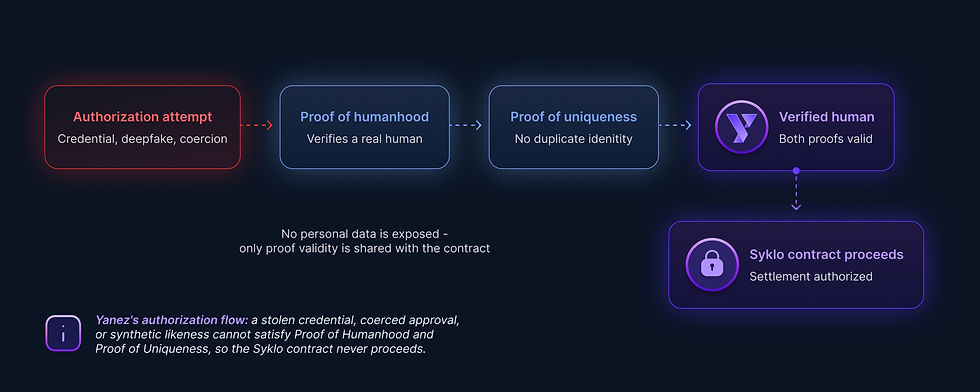
Yanez's authorization flow: a stolen credential, coerced approval, or synthetic likeness cannot satisfy Proof of Humanhood and Proof of Uniqueness, so the Syklo contract never proceeds.
Layered onto a Syklo settlement, this closes the loop that the Bittensor case and the deepfake-enabled wire fraud cases both exposed. On the happy path, the contract already has no unilateral release step for a forged document or a spoofed message to act on. Yanez's proofs ensure that the act of authorizing the contract in the first place — and, where relevant, the act of participating in a dispute-path adjudication — cannot be satisfied by a stolen credential, a coerced approval, or a synthetic likeness, because the system is checking for a verified, unique human, not merely a message or a face that looks like one.
Combined Settlement Flow: Syklo + Yanez
Attack Attempted | Outcome Under Syklo + Yanez |
Forged wire confirmation submitted to release escrowed assets. | Rejected — release conditions are checked against verified settlement state, not submitted documents. |
Triangle scam linking an unrelated buyer and seller through fabricated payment details. | Rejected — funds and assets only move between parties whose authorization satisfies the contract's predefined conditions. |
AI-generated voice or video impersonating an authorized counterparty. | Rejected — Proof of Humanhood and Proof of Uniqueness require a verified, non-duplicated human authorization that a synthetic likeness cannot satisfy. |
Stolen credentials or a leaked API key used to attempt authorization. | Rejected — authorization depends on the human proof layer, not possession of a credential alone. |
Each attack category from Section 3 mapped against the combined defense, illustrating that the two layers address distinct failure points rather than duplicating coverage.
Conclusion: Settlement Should Not Depend on What a Human Is Willing to Believe
The incidents examined in this article — a Bittensor subnet's OTC settlement, triangle scams on P2P platforms, and multimillion-dollar deepfake-enabled wire transfers — differ in their tooling but share a single point of failure: a settlement process that gives a single human unilateral authority to evaluate a piece of communication and decide, on their own, whether it is genuine enough to release funds or assets. As fabrication tools improve, that decision becomes harder to make correctly, no matter how diligent or experienced the person making it is.
Constraining unilateral release authority to the happy path, reserving human review for an explicit and bounded dispute process, and replacing communication-based authorization with cryptographically verified, privacy-preserving proof of human authorization, together address that failure mode without pretending settlement risk can be reduced to zero. Syklo's escrow architecture and Yanez's Proof of Humanhood and Proof of Uniqueness form a settlement model in which ordinary transactions move only when mathematics and verified human identity agree, and in which the human judgment still required for genuine disputes is explicit, limited, and structurally separated from full custody — not exercised, unaccountably, by a single intermediary who could be fooled, pressured, or bought.